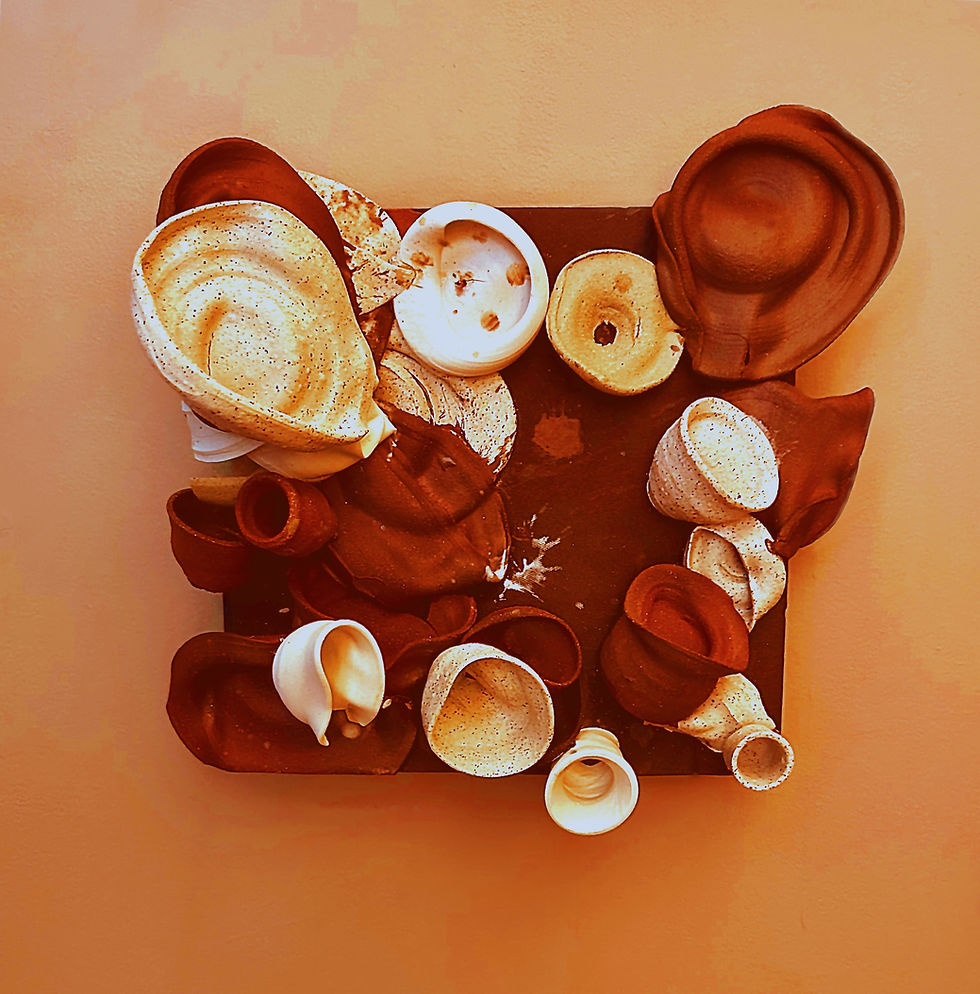
%20Earful%20-%20stoneware%20-25.jpg)
PERFECTLY IMPERFECT
%20Sliver%20I.jpg)
Art was a passion for me starting as a young child. My mother made sure to keep the "art closet" stocked with supplies: colorful paints, pens and other various media. It was in my art that I accessed my creativity that helped me escape my oppressive home environment. I had the freedom to do and make anything I wanted free of scrutiny. It truly saved my life in those early years.
Later in my primary education, I was told by a teacher - "that's not how you draw a flower" - in reference to a piece I made. My response to this edict at the time was to shut down my creativity feeling the bias and judgment that until then I had evaded with my artistic expression.
It wasn't until years later that I rediscovered my creativity in large part to the credit of my first ceramics teacher at the University of Washington, Patti Warashina. She saw that I was not interested in the confines of the hand-building "assignment" given to the class, but rather in throwing vessels on the pottery wheel that | then altered into human forms. Rather than hold me to the expectations of the class assignment, she modified mine to require that I make more of the objects I was making just asking that I make them "twice as big" and to make "twice as many" of them.
This act of meeting me where I was and encouraging my unique expression of the art subsequently inspired my artistic practice and my instruction of art to others as a teacher's assistant in graduate school. I saw my work as sometimes coaxing out the creativity of others rather imposing a rigid structure re art assignments on them. In reality, higher education and art are oxymorons as art is not meant to be restricted to assignments or by subjective "grading" by others.
These valuable lessons inspired my gravitation towards the field of psychology. As a therapist, and ultimately a psychologist I had the opportunity and the gift to work with others to assist them in accessing and expressing their unique creative expression of self. Often involving working with them to free themselves of the conditioning, expectation and trauma that impinged on the creative unique expression of who they truly were.
We live in a culture that largely puts us in boxes and hold us to perfectionistic expectations of how to be, look, think, act, believe and behave all motivated by fear...fear of rejection, fear of not fitting in, fear of judgment the SHAME associated with these fears. To think, or step outside of the lines is unacceptable. We are held to a standard of perfection that is unattainable.
"You are never white enough, male enough, strait enough, attractive enough, able enough, successful enough, rich enough..."
"Don't feel bad, feel good!"
"To share your vulnerability is weakness."
As a psychologist, I have witnessed and continue to witness how fear Informs so much of the dis-ease suffered by myself and others. My therapeutic work is to help people access their creative resources, often in unorthodox ways, to overcome these barriers to self-expression and self-love. As with my art, l encourage them to think and be "outside of the box" of their conditioning to be their true selves and thrive - "PERFECTLY IMPERFECT".
In fact, I work with them to help them to embrace Imperfection - a very non-Western concept. In traditional Japanese aesthetics, there Is such a practice that is known as wabi-sabi.
This ancient concept Is centered around the acceptance of the fleeting nature of reality and the truth of impermanence including principles of "asymmetry, roughness, simplicity, economy, austerity, modesty, and an appreclation and the forces of nature"(reference 1). It Is the act of celebrating flaws, transience and authenticity over the the unattalnable, rigid standards of perfectionism"(reference 2).
Key health benefits of wabi-sabl include reduced stress and anxiety, enhanced mental and physical well-being, increased mindfulness, and enhanced self-acceptance and calm(references 3,4).
Once practice of wabi-sabi is Kintsugi — the traditional Japanese art of mending broken ceramics with gold — often powdered gold flake and glue or resin (Reference 5). The breakage of the plece is a part of its history to be valued -appreciating the beauty in its resilence, something to be treasured (references 5,6).
Celebrate the PERFECTLY IMPERFECT!
-
*Wabi-Sabi Definition | Japanese Design Philosophy of Imperfection". 7 April 2026.
-
"Japanese Aesthetics". Stanford Encyclopedia of Philosophy. Retrieved 31 October 2022.
Lomas, T., Etcoff, N., Van Gordon, W., & Shonin, E. (2017). Zen and the art of living mindfully:
The health-enhancing potential of Zen aesthetics. Journal of Religion and Health, 56, 1720-1739. https://dol.org/10.1007/s10943-017-0446-5 -
Navarro, T. (2021). Kintsugl: Embrace your imperfections and find happiness - the Japanese way. Yellow Kite.
-
Poplin, J. (n.d.). The many benefits of choosing to live simply. The Simplicity Habit. Retrleved October 5, 2021, from https://www.thesimplicityhabit.com/benefits-simple-living/
-
"Kintsugl: The Centuries-Old Art of Repairing Broken Pottery with Gold". My Modern Met. April 25, 2017. Archived from the original on October 10, 2018.
-
"Golden Seams: The Japanese Art of Mending Ceramics", Freer Gallery of Art, Smithsonlan, archived from the original on March 17, 2009, retreved March 3, 2009.